
Copy of Vantabs.com

Why Most Small Businesses Are Invisible Online And the System That Changes It

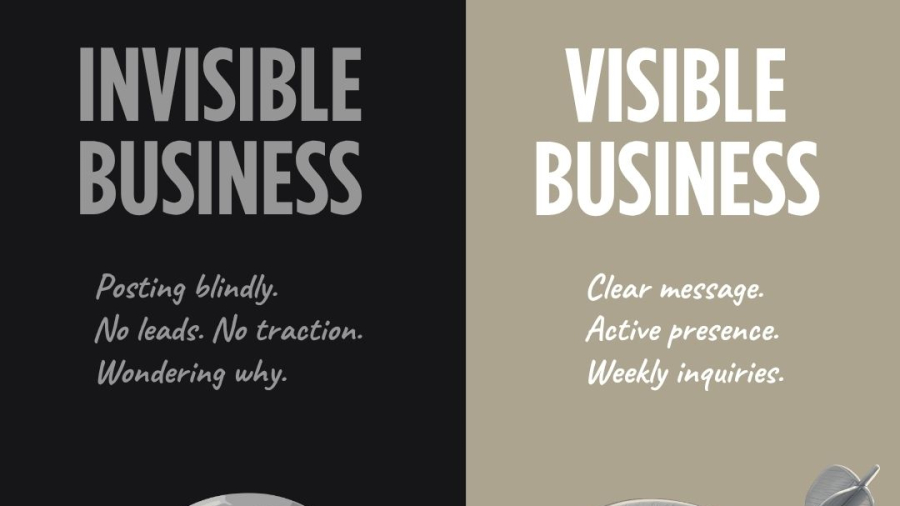
Most small business owners have built something worth paying for. Their existing customers love them. Word of mouth is decent. But online? They’re practically invisible while competitors who are objectively worse are showing up everywhere, pulling in enquiries from people they’ve never met.

Here’s what nobody tells you: that’s not a budget problem. It’s a system problem.

The Real Reason You’re Not Getting Found

The most common advice given to struggling business owners is useless: “just post more consistently.” As if volume is the issue.

Posting more of the wrong content, to the wrong audience, with no strategy behind it doesn’t build a business. It wastes your time and creates a cluttered, directionless presence that tells potential customers you haven’t thought clearly about your own brand.

The businesses winning online right now aren’t posting more. They’re posting smarter — and there are three traps keeping everyone else stuck.

Trap 1 — No clear positioning. If your Instagram bio, your website, and your Google listing all say something slightly different about what you do, you have a positioning problem. Confusion is the enemy of trust. A confused visitor doesn’t become a paying customer. They leave.

Trap 2 — Inconsistency. Every platform algorithm rewards reliability. Businesses that post sporadically and go quiet for weeks are actively penalised. The platform learns you’re unreliable — and your reach reflects that.

Trap 3 — No conversion pathway. Visibility without direction is just noise. If someone finds your content, likes what they see, and has no obvious next step — they won’t take one. Every piece of content needs one clear door.


The System That Changes It

Businesses that go from invisible to in-demand don’t discover a secret tactic. They build a system and run it consistently. It has five layers.

1. Position first. Before you post anything, complete this sentence: “We help [specific audience] to [specific outcome] — without [common obstacle].” If you can’t do it in ten seconds, your audience can’t either. Every piece of content you ever publish flows from this one clarified statement.

2. Choose one platform and commit. Don’t be mediocre on five channels. For most consumer-facing SMEs: Instagram for brand building and lead generation, Google Business for local search, and email for nurturing. Master these three before expanding anywhere else.

3. Build brand consistency. Two colours. Two fonts. One logo. One tone of voice. When someone sees your content on Instagram, then finds you on Google, then visits your website — it should feel like the same brand speaking every time. Inconsistency signals a business that hasn’t taken itself seriously.

4. Lead with value. 80% of your content should give something — educate, entertain, inspire — with no strings attached. 20% can be a direct offer. People don’t follow brands that only talk about themselves. They follow brands that make them smarter or more informed. Build the relationship first. The sale follows.

5. One clear next step, every time. Not “follow us, share this, call us, visit our website.” Pick one door per post and make it obvious. Clarity converts. Confusion doesn’t.


The Cost of Staying Invisible

The dangerous thing about having no digital strategy is that the cost is silent. Unlike a failed ad campaign where you can see the spend, the cost of inaction shows up as customers you never knew existed choosing someone else. Every person who searched for your service, found a competitor, and never knew you were an option. Every referral who looked you up, couldn’t find a credible presence, and quietly moved on.

The businesses building their digital systems right now aren’t just winning today’s customers. They’re building social proof, organic reach, and reputation that compounds over time. The longer you wait, the wider the gap becomes.


Where to Start

You don’t need to know everything about digital marketing to begin. You just need to begin with the right foundation — clear positioning, one platform, consistent content, and a single conversion pathway.

At some point, the smartest move is to stop doing this yourself. Your time has a cost. The hours you spend figuring out strategy, designing posts, and chasing analytics are hours away from running your actual business. A proper digital marketing partner compresses months of trial and error into a working system from day one.

The difference between the businesses you admire online and where you are right now isn’t luck. It’s not budget. It’s a system — and that system is available to you.


Ready to close the visibility gap? Book a free 30-minute strategy call with Vanta — no pitch, just clarity on exactly what your business needs next.

pexels-alphatradezone-5831696 (1)

How Analytics Can Grow Your Business in South Africa


Most South African SMEs Are Flying Blind — Here’s How to Fix That

You started your business with a vision. You’ve put in the hours, built a client base, and kept the lights on. But if you’re making key decisions on gut feel alone, you’re not just leaving money on the table — you’re handing it to competitors who aren’t.

Business analytics is no longer a luxury reserved for corporate giants. In 2025, it’s the single most powerful tool a South African SME can use to stop guessing and start growing. Whether you’re in Durban, Johannesburg, or Cape Town — data is the great equaliser.


What Is Business Analytics, Really?

Strip away the jargon: analytics is turning your business data into decisions that make you money.

That means knowing which marketing channels actually bring in clients, which services carry your margins, which customers are worth keeping — and where your operations are leaking time and money.

Most South African SMEs are already sitting on this data. They just don’t have the systems to read it.


The Real Cost of Not Using Analytics

Wasted marketing spend. The average SME wastes 30–50% of its marketing budget on channels that aren’t converting. Without analytics, you have no way to know which half.

Missed revenue opportunities. If you can’t see which services or client segments drive your highest margins, you can’t double down on them. You spread effort across everything — which is the same as investing in nothing.

Slow response to problems. A spike in churn, a drop in conversion, a cost blowout — analytics lets you catch it early. Without it, you find out when it’s already a crisis.

Decisions by opinion, not evidence. Analytics ends the internal debate fast and points everyone in the same direction.


5 Ways Analytics Directly Drives SME Growth

1. Know Exactly What’s Working in Your Marketing

South African consumers are increasingly digital — Instagram, Google, WhatsApp, and beyond. But reach without conversion is noise. Analytics tells you which platforms, content types, and messages are actually producing leads and sales — so you stop funding what doesn’t work and pour fuel on what does.

At Vanta, we build custom marketing analytics reports that break down performance by platform, campaign type, and time period — giving you a clear return on every rand spent.

2. Understand Your Most Profitable Customers

Not all revenue is equal. Some clients generate enormous value; others consume more resources than they’re worth. Customer analytics helps you identify your most profitable segments, understand what they have in common, and build your marketing around attracting more of them.

It’s one of the fastest ways to grow revenue without growing your cost base.

3. Make Smarter Operational Decisions

Where are your biggest inefficiencies? What’s your actual cost per client? Without data, these questions get answered by assumption. With analytics, they get answered by fact — and the savings are often significant.

This is especially powerful for service-based businesses, where time is the core resource being sold.

4. Track Growth in Real Time

Goals without tracking are wishes. Analytics gives you dashboards that monitor revenue, leads, conversion rates, and client retention — weekly or monthly. You always know where you stand and what needs attention.

5. Outmanoeuvre Competitors Who Are Still Guessing

Most of your direct competitors are not using analytics properly. They’re making the same decisions they made three years ago, based on the same assumptions. When you build a data-driven operation, you don’t just perform better — you develop a structural advantage that compounds over time.

That’s what we mean by your unfair advantage.


“But I’m Not a Data Person”

You don’t need to understand statistical models or build dashboards from scratch. You need the right systems, the right data pulled, and clear actionable insights you can use in your next meeting.

That’s exactly what Vanta’s analytics service delivers. We handle the technical layer so you can focus on making better decisions faster.


What Good Analytics Looks Like for an SME

You don’t need enterprise software or a data scientist on payroll. You need:

  • Clear tracking of your key revenue and marketing metrics
  • Regular reporting that surfaces insights, not just numbers
  • A structured approach to reviewing data and acting on it
  • Integration with tools you’re already using

When those four things are in place, analytics stops being a buzzword and starts being a competitive weapon.


The Vanta Approach: Analytics Built for Real Businesses

Analytics sits at the heart of everything we do at Vanta Business Solutions. We don’t just report data — we connect it to your marketing strategy and operational systems to create a complete picture of your business performance.

Our clients across South Africa — from growing SMEs in Durban to scaling businesses in Johannesburg and Cape Town — use Vanta’s analytics support to:

  • Identify which marketing investments are actually paying off
  • Build monthly performance reports they can share with stakeholders
  • Spot growth opportunities they didn’t know existed
  • Make faster, more confident business decisions

Ready to Make Data Your Unfair Advantage?

Getting started is simpler than you think. Book a free strategy session with the Vanta team and we’ll show you exactly what your current data can unlock — and what it means for your growth.

pexels-pixabay-267415

5 Ways Smart Marketing and Business Optimization Can Transform Your Business

Smart marketing and business optimisation can transform your business by replacing guesswork with systems attracting the right clients, automating the follow-up, and giving you the data to make decisions that actually move the needle. Here are five ways to make it work for your business.

Companies that invest in business optimization and digital marketing often experience faster growth, higher revenue, and stronger customer relationships. In this article, we’ll explore five powerful ways marketing and optimization can transform the way your business operates and grows.

1. Attract More Customers With Strategic Digital Marketing

One of the biggest challenges businesses face is attracting the right customers. Digital marketing helps businesses connect with people who are actively searching for their services.

Strategies such as search engine optimization (SEO), social media marketing, and targeted online advertising allow businesses to reach a larger audience while focusing on customers most likely to convert.

When implemented correctly, digital marketing can:

  • Increase website traffic
  • Generate qualified leads
  • Improve brand awareness
  • Drive more sales

Instead of relying on traditional marketing alone, businesses can use modern digital strategies to create consistent and predictable growth.

2. Turn Your Website Into a Lead Generation Machine

Many businesses treat their website like an online brochure. However, a properly designed website should function as a powerful marketing tool that generates leads and customers.

High-performing websites focus on:

  • Clear messaging that communicates value
  • Fast loading speeds and mobile responsiveness
  • Strong calls-to-action that guide visitors
  • SEO optimization to improve search rankings

A well-designed website helps build trust and encourages visitors to take action, whether that means booking a consultation, requesting a quote, or purchasing a product.

3. Improve Efficiency With Business Automation

Business optimization is not only about marketing. It’s also about creating systems that allow your business to run more efficiently.

Automation tools can help streamline repetitive tasks such as:

  • Appointment scheduling
  • Customer follow-ups
  • Email marketing campaigns
  • Lead management

By automating these processes, businesses save time and reduce manual work. This allows business owners and teams to focus on high-value activities such as strategy, customer service, and growth initiatives.

Automation also improves consistency, ensuring that customers receive timely communication and a better overall experience.

4. Make Data-Driven Decisions for Better Results

Successful businesses rely on data rather than guesswork. Modern marketing platforms and analytics tools provide valuable insights into how customers interact with your brand.

Businesses can track key metrics such as:

  • Website traffic and visitor behavior
  • Conversion rates
  • Marketing campaign performance
  • Customer acquisition costs

By analyzing this data, companies can identify what works and what doesn’t. This allows them to refine their marketing strategies and allocate resources more effectively.

Data-driven decision making helps businesses continuously improve their results and maximize return on investment.

5. Create a Scalable Growth Strategy

Many businesses struggle to grow because their processes are not designed for scale. Without proper systems and strategies in place, growth can lead to operational challenges and inefficiencies.

Business optimization focuses on creating structured systems and scalable marketing strategies that support long-term expansion.

This may include:

  • Implementing customer relationship management (CRM) systems
  • Developing automated marketing funnels
  • Optimizing internal workflows
  • Improving brand positioning and messaging

When these elements work together, businesses can handle increased demand while maintaining quality and efficiency.

Final Thoughts

In today’s competitive marketplace, businesses must combine effective marketing strategies with optimized systems to achieve sustainable growth.

Digital marketing helps attract new customers, while business optimization ensures that operations run smoothly and efficiently. Together, these elements create a powerful foundation for long-term success.

Businesses that invest in modern marketing and smart systems are better positioned to adapt to changing market conditions, improve customer experiences, and scale their operations.

If your business wants to increase leads, streamline processes, and accelerate growth, focusing on marketing and business optimization could be the key to unlocking your full potential.